
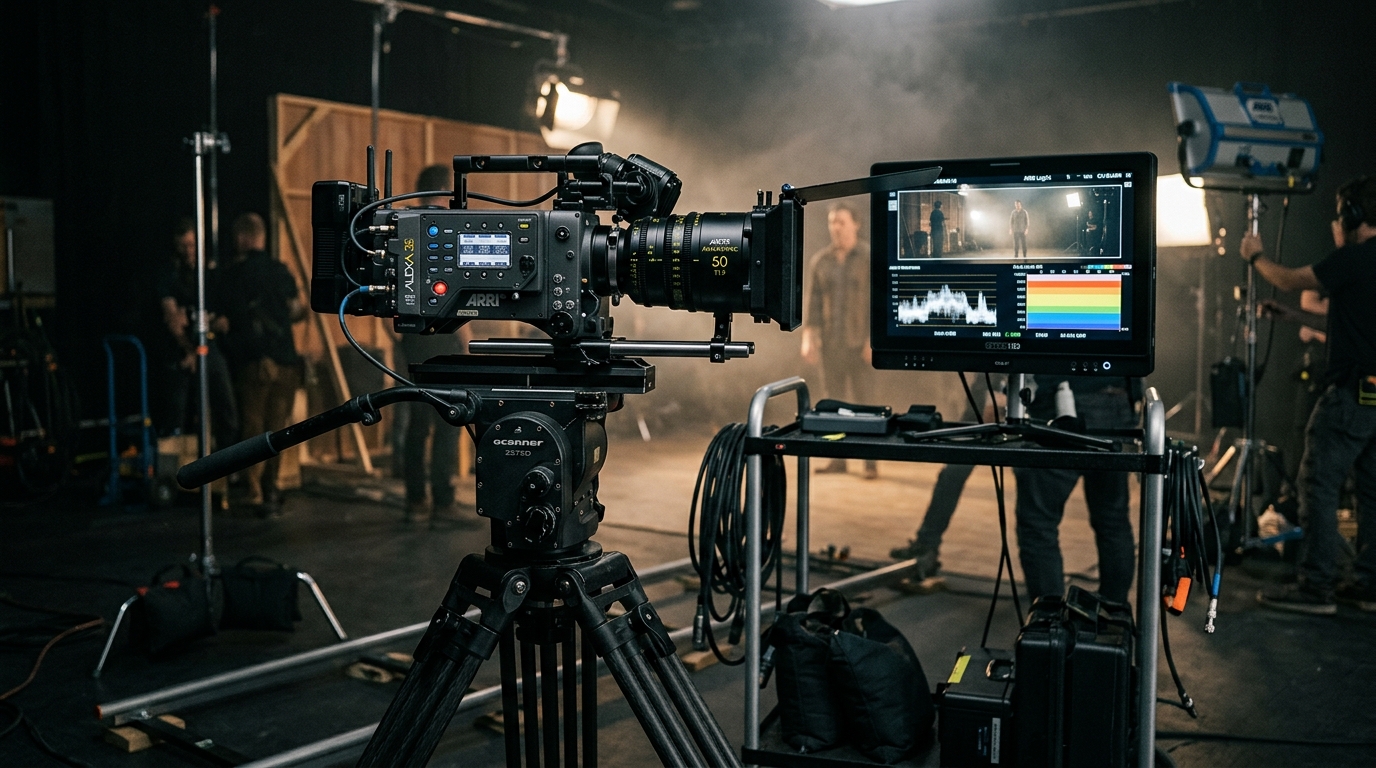
1. The 17-Stop Architecture: The Engineering of LogC4
With the release of the Alexa 35 and the ALEV 4 sensor, ARRI established an unprecedented benchmark in cinema imaging: 17 stops of dynamic range. This represents a 2.5-stop increase over the legendary ALEV 3 sensor found in the Alexa Mini and Amira, expanding highlight headroom by nearly an entire stop while simultaneously suppressing noise in the deepest shadows.
To accommodate this massive dynamic latitude without introducing severe quantization stepping, ARRI engineered an entirely new mathematical logarithmic transfer function: LogC4. LogC4 allocates code values differently than LogC3, requiring dedicated color management pipelines and updated 3D LUT matrices.
2. Middle Gray Shift: 39.2% IRE vs. LogC3's 38.4%
In digital cinematography, middle gray (18% reflectance) is the universal calibration anchor. Cinematographers accustomed to LogC3 frequently underexpose LogC4 because the curve's distribution of stops above and below gray has been re-architected.
| Profile / Curve | Dynamic Range | 18% Middle Gray | Stops Above Gray | Stops Below Gray |
|---|---|---|---|---|
| ARRI LogC4 (Alexa 35) | 17.0 Stops | 392 IRE (400 code) | 8.0 Stops Headroom | 9.0 Stops Shadow Detail |
| ARRI LogC3 (Alexa Mini/LF) | 14.5 Stops | 384 IRE (400 code) | 7.1 Stops Headroom | 7.4 Stops Shadow Detail |
| Sony S-Log3 (FX3/Venice) | 15.0+ Stops | 410 IRE (420 code) | 6.0 Stops Headroom | 9.0+ Stops Shadow Detail |
| Canon C-Log2 (C70/C300 III) | 16.0 Stops | 340 IRE (348 code) | 7.5 Stops Headroom | 8.5 Stops Shadow Detail |
3. ARRI Wide Gamut 4 (AWG4): Color Space Volume
Together with LogC4, ARRI introduced ARRI Wide Gamut 4 (AWG4). AWG4 is significantly larger than Rec.2020 and DCI-P3, and is specifically designed to encompass all naturally occurring surface colors under theatrical lighting, including saturated neon LED gels and practical stage flares.
Crucially, AWG4’s primary chromaticities are mathematically optimized to prevent "virtual colors"—chromatic values that fall outside the human visual locus (CIE 1931 xy). This guarantees smooth, natural roll-off when mapping intense theatrical blues, cyan water reflections, and sodium-vapor orange night streets down to standard Rec.709.
4. The REVEAL Color Processing Chain
The REVEAL Color Science pipeline is not a simple LUT; it is a modular five-stage processing architecture:
- ADA-7 (ARRI Debayer Algorithm 7): Advanced sub-pixel reconstruction producing cleaner edges and reduced false moiré.
- ACE-4 (ARRI Color Engine 4): Mathematical color conversion matrix transforming raw bayer sensor triplets into camera-independent AWG4 coordinates.
- LogC4 Curve Engine: Encoding 17 stops of tonal information into 12-bit ProRes or ARRIRAW containers.
- ARRI LUT4: High-precision tetrahedral 65³ 3D lookup tables converting AWG4/LogC4 into calibrated Rec.709 delivery.
5. Production False Color Exposure Legend
Red (99-100%): Sensor Clip / Specular White clipping threshold.
Yellow (95-98%): Highlight Roll-off buffer zone (preserve cloud/sky textures).
Green (38-42%): 18% Neutral Middle Gray card target.
Pink (52-58%): Caucasian skin tone highlight reflectance.
Blue (2.5-4.0%): Shadow threshold above sensor quantization noise.
Purple (0-2.0%): Crushed Black / Zero information zone.